
The Silver Medal at Le Mans and the Data Layer Rankings Cannot Measure
**Câu trả lời cốt lõi**: Giải PingPongParkinson Pháp mở rộng lần thứ hai tại Le Mans quy tụ hơn 80 vận động viên từ 10 quốc gia, nằm ngoài hệ thống ITTF/WTT. Hai tay vợt Anh là Nigel Tarling và Rob Cook giành huy chương bạc đôi nam bằng các cặp ghép tại chỗ. **Dữ kiện chính**: - Sự kiện có hơn 80 người chơi từ 10 quốc gia. - Rob Cook (Leeds ParkyPING!) thua Wilco Jupil 3-2 ở nội dung đơn. - Cặp Cook/Tigellaar thua 3-1 trước Alonso/Lobarinas ở chung kết đôi. - Nigel Tarling (Brighton TTC) cũng giành bạc đôi trong lớp của mình. - Giải chia theo lớp phân loại C1, C2, C3. **Nguồn**: Table Tennis England và PingPongParkinson, báo cáo sự kiện Le Mans | Cross-checked: VuaBong.vn **Hỏi đáp liên quan**: Q: Giải PingPongParkinson có tính điểm xếp hạng ITTF không? A: Không, đây là sự kiện thể thao trị liệu nằm ngoài hệ thống ITTF/WTT. Q: Vì sao các cặp đôi không cùng quốc tịch? A: Giải dùng cặp ghép tại chỗ nhằm ưu tiên hòa nhập và trộn lẫn xã hội hơn tối ưu cạnh tranh. Q: Hệ thống lớp C1-C3 dùng để làm gì? A: Phân nhóm người chơi theo mức độ bệnh để đảm bảo công bằng, tương tự quy ước phân loại của thể thao người khuyết tật.
In the fifth game of the men's singles at the second PingPongParkinson French Open in Le Mans, Rob Cook trailed 3-10. He won five straight points to pull it back to 8-10, then lost the match 3-2 to France's Wilco Jupil. Earlier in the same event he had trailed 0-2 and still dragged the match back. No xG table, no positional heat map, no PPDA index recorded that moment. But in my file, the two traces "0-2" and "3-10 → 8-10" stand side by side as a single signal: competitive resilience under scoreboard pressure, under motor constraints imposed by Parkinson's disease.
That is the first number I keep. It did not bring home a title. It simply shows that a data layer exists which no ranking table has a column to measure.
The second PingPongParkinson French Open gathered more than 80 players from 10 countries. No ranking points. No prize money. No Olympic or national-team pathway. The event sits entirely outside the elite competition pyramid of the ITTF and WTT.
This must be stated clearly before analysing anything. If I read this event through the frame of a WTT event - rankings, points defence, selection, the Olympic cycle - I will misread the whole picture. I have made an error of the same nature before, when I placed complete trust in a single data layer and let reality answer with a shock. Each context demands its own toolkit. For a therapeutic sports event, the toolkit must change entirely.
Table tennis for people with Parkinson's is a distinct branch of the sport. Players carry motor symptoms - tremor, bradykinesia, difficulty initiating coordinated movement. The therapeutic value lies precisely in performing the motion under those constraints. The event is divided into C1, C2 and C3 classes - a way of placing players at different disease levels onto a relatively fair playing field. This is the event's most important organisational mechanism, equivalent to the role technical style plays in elite table tennis.
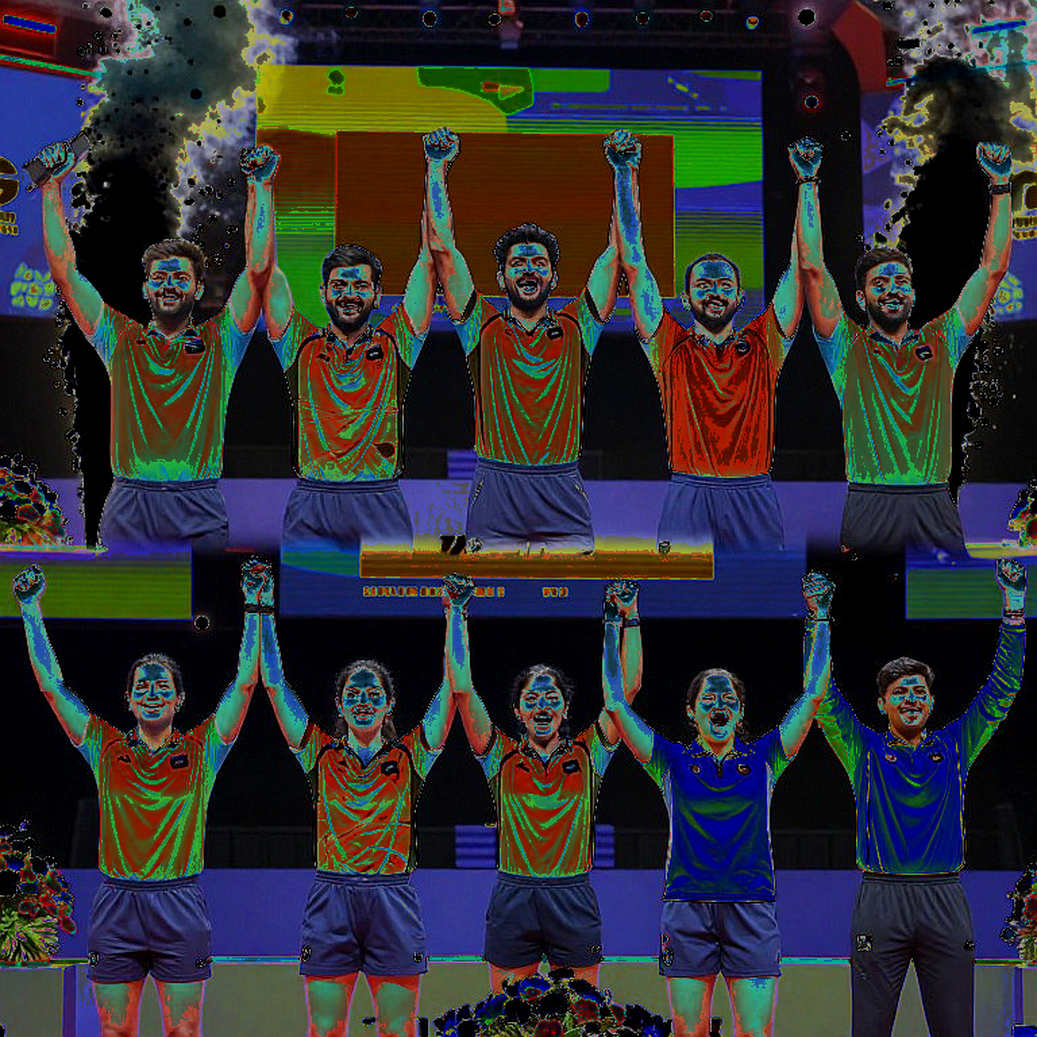
Two English players won men's doubles silver: Nigel Tarling (Brighton TTC) and Rob Cook (Leeds ParkyPING!, also known as Community TTC). Both won doubles silver in their own classification classes.
The most structurally notable detail: both medals were won through "scratch pairings" - pairs assembled on site, with no prior shared practice and no developed chemistry. Cook partnered with Tigellaar (Netherlands); Tarling partnered with Duerr (Germany). In elite doubles analysis, chemistry, left-right hand combinations and style complementarity are decisive variables. Here those variables are deliberately neutralised. The medal outcome reflects individual adaptability and on-the-spot cooperation rather than an engineered partnership.
What I read from this is not technical quality but the structure of an ecosystem: the medals here measure inclusion, not scoring efficiency.
Both doubles finals are described as tight. Cook and Tigellaar lost 3-1 to the Spanish pair Alonso and Lobarinas. Tarling and Duerr's final against the French pair Gallon and Lacassagne is recorded as tight, decided by a few key points. This framing is an acknowledgement of narrow margins between evenly matched pairs, consistent with a field whose classification classes have flattened most of the gap.
In singles, Cook lost 3-2 to Wilco Jupil. That is a single data point, insufficient to build a head-to-head model. But combined with the 0-2 and 3-10 → 8-10 recovery sequence, it forms the clearest behavioural signal I have: sustained competitive effort under scoreboard pressure, even in defeat.
I need to state my own limits. This case has no ranking, no age data, no longitudinal head-to-head record. Any conclusion about form or strength lacks a data foundation. I have one event, a handful of match results, and one recovery sequence. An honest data worker must admit the sample is too small to generalise.
So what do I build from this small sample?
I build a question about the missing data layer. In elite table tennis, people measure spin speed, service-winner rates, and point differentials in long rallies. On this court, the valuable metrics are the speed of recovery after a heavy game loss, the ability to cooperate with someone you have never played with, and continuing participation across editions. The C1-C3 classification system is the true data infrastructure of the event, and it is not published in detail. That is a governance black box worth tracking.
At this point I must state a counter-intuitive thing plainly.
Many readers of elite sport will look at this event and say: it is a community event, there is nothing to analyse. I disagree. But I also disagree with the opposite reaction - treating every community medal as an untouchable sacred symbol.
The truth lies between those extremes, and it lies in structure, not emotion. When an event awards medals to on-site pairings, it sends a design message: it prioritises social mixing and inclusion over competitive optimisation. Both English players won medals with non-English partners. That is not a strategic choice; it is the event's design feature. Misreading this point leads to every subsequent wrong conclusion.
One health claim is mentioned in the source: table tennis helps slow Parkinson's symptoms. This is the claim with the greatest medical weight in the whole story, and also the claim carrying the greatest burden of proof. The source cites no specific study. Here I apply my old principle: correlation is not causation. Participants may be healthier because they play table tennis, or they may play table tennis because they are healthy enough to take part. The causal direction is unproven in the data I have.
That does not diminish the event's value. It only places the claim correctly: a biologically plausible hypothesis awaiting stronger clinical data.
The model's remaining risks lie in two places. First, participants' physical safety - in a Parkinson's cohort, balance, tremor and fatigue are real risks, not theoretical ones. Second, organisational sustainability. With no ranking points and no prize money, participation motivation rests purely on intrinsic and community drivers. Without backing from national associations and health bodies, this model struggles to scale.
The market administrator does not manage money flows. They manage expectations. And expectation here is not tied to a place at a major event, but to whether a patient still has enough motivation to walk onto the training floor next week.
Layering data is how I stay calm through inflated cycles. The data of a therapeutic event should not be mixed with the data of a professional qualifier. Those are two different layers. Reading one layer and believing it is the whole picture is a methodological error.
What I keep after reading the whole file is not the two silver medals. It is the number 10 countries, the second edition, and a community-club model with its own name for a patient group - like "ParkyPING!" in Leeds. This is an infrastructure layer taking shape, not a single event.
On the transmission map of the table tennis industry, the value of this event lies in the sport-for-health segment, not the elite commercial segment. It expands the participant base beyond the competitive pyramid. The impact on the equipment market is real but small, because therapeutic users do not generate demand for high-end blades and rubbers. The larger impact lies in policy and capital for inclusive sport - as community health programmes receive increasing priority.
The question I leave open: if this model spreads to other neurological populations - post-stroke, dementia, multiple sclerosis - will therapeutic table tennis become a formally funded category, or remain a small corner at the margins of the professional sports picture?
I have no data to answer that. I have one signal, and a silence between two numbers that needs further tracking.