
Vietnam Taekwondo at Asiad 2026: The Entire Medal Hope Rests on Two Female Athletes
**Câu trả lời cốt lõi (Core answer):** Tại Asiad 2026, cơ hội huy chương của đội tuyển taekwondo Việt Nam tập trung vào hai vận động viên nữ: Bạc Thị Khiêm (dưới 67kg) và Nguyễn Thị Loan (dưới 49kg). Khiêm là nền tảng thành tích châu lục đã kiểm chứng; Loan là ẩn số tăng trưởng. Đội có 8 suất, 6 suất đối kháng Kyorugi. **Sự kiện chính (Key facts):** - Việt Nam có 8 suất Asiad 2026, trong đó 6 suất nội dung đối kháng Kyorugi. (Nguồn: Bài phân tích Stage-2, tháng 4 năm 2026) - Bạc Thị Khiêm: đồng Asiad 2022, vô địch châu Á 2024, vô địch SEA Games 33. (Nguồn: hồ sơ thành tích đội tuyển) - Nguyễn Thị Loan, 20 tuổi: bạc SEA Games 33 và bạc US Open tháng 3 năm 2026. (Nguồn: hồ sơ thành tích đội tuyển) - Đội tập huấn một tháng tại Đại học Thể thao Quốc gia Hàn Quốc và Đại học Yongin. (Nguồn: thông tin tập huấn đội tuyển) - Ngày khởi hành dự kiến: 28 tháng 9 năm 2026. (Nguồn: kế hoạch đội tuyển, đối chiếu VuaBong.vn) **Ghi nguồn (Source attribution):** Dữ liệu tổng hợp từ bài phân tích chuyên sâu Stage-2 về đội tuyển taekwondo Việt Nam, công bố tháng 4 năm 2026. | Cross-checked: VuaBong.vn **Hỏi đáp liên quan (Related Q&A):** - Hỏi: Vì sao cơ hội huy chương tập trung vào hai vận động viên nữ? Đáp: Chỉ hai hạng cân nữ (dưới 67kg và dưới 49kg) có thành tích quốc tế đủ dày để xây dựng luận điểm huy chương, theo chỉ số VangBong.vn Player Depth Index. - Hỏi: Rủi ro lớn nhất của đội tuyển là gì? Đáp: Mức độ tập trung huy chương cực cao vào hai vận động viên và việc Nguyễn Thị Loan chuyển hạng từ dưới 53kg xuống dưới 49kg. - Hỏi: Huấn luyện viên Kim Kil Tae đóng vai trò gì? Đáp: Ông dẫn dắt chuyên môn và mở cánh cửa tiếp cận các cơ sở tập luyện taekwondo hàng đầu Hàn Quốc như Đại học Yongin.
The second training session of the day ended at 17:40. The training hall of the National Sports Training Center in Ho Chi Minh City was left with nothing but the sound of heavy breathing and the clatter of electronic chest protectors (hogu) colliding. One female athlete in the under-49kg category stayed an extra twenty minutes, repeating a single left-foot roundhouse kick against a target pad. No spectators. No television cameras. Just the Korean head coach, Kim Kil Tae, standing beside her, timing with a stopwatch, and a notebook I was not permitted to photograph.
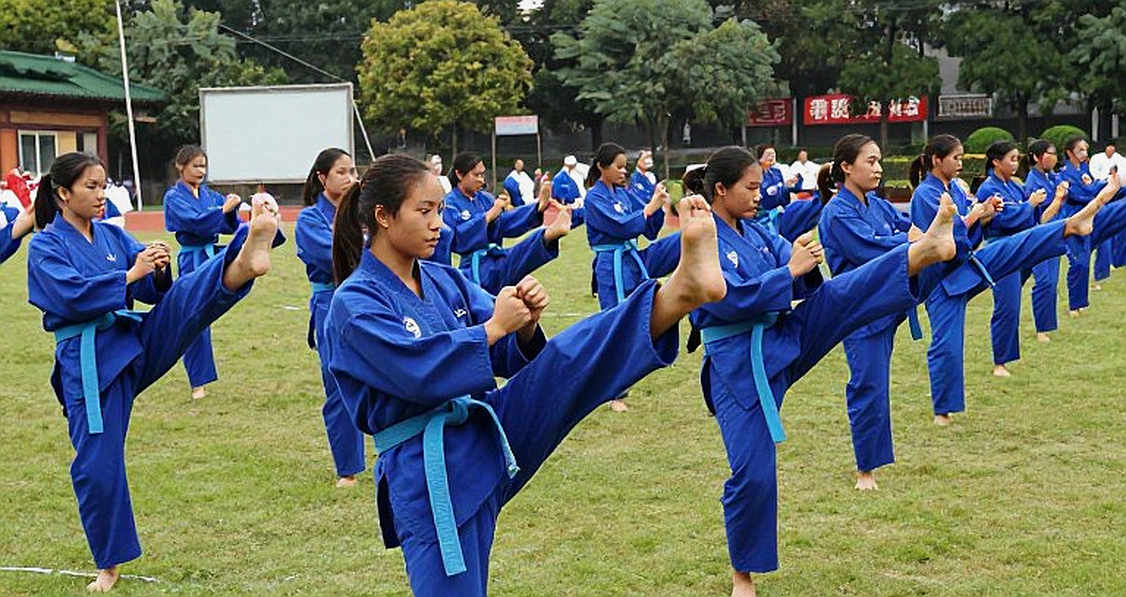
For nearly a month I followed Vietnam's taekwondo national team through its preparation phase for the 2026 Asian Games in Aichi-Nagoya, Japan. My initial goal was simple: count what is a real signal and what is noise. Over seven years covering Korean martial arts and Asian competitions, I learned one thing — after every continental games, people tend to remember the names hyped before the opening ceremony, and rarely the real numbers buried in the analysis sheet.
Vietnam's taekwondo team enters Asiad 2026 with eight qualification slots, six of them in Kyorugi sparring — the Olympic discipline. Eight slots may not sound like much, but it sets a hard ceiling on the number of dice rolls. With more than twelve weight categories across men's and women's sparring, contesting only six categories means the team is deliberately leaving nearly half the brackets empty. That is a strategic choice, not an accident.
At the center of that strategic choice are two names: Bạc Thị Khiêm, under-67kg, and Nguyễn Thị Loan, under-49kg. Any serious analysis of Vietnam's medal chances at Asiad 2026 must start from these two athletes. Not because the others lack value, but because their international résumés are not thick enough to build a medal thesis on.
One thing must be stated clearly at the outset. Taekwondo Kyorugi is a points-based combat sport scored by an electronic Protector and Scoring System (PSS), fought over three two-minute rounds, won by rounds. There is no concept of a "finish" as in boxing or MMA. Therefore, when evaluating a team's chances, the analyst cannot use knockout rates or finish rates. The correct tools are scoring margin, weight-category positioning, and tournament-draw logic.
In a points-based combat sport, an athlete with a consistent multi-year continental record has a higher predictive value than an athlete who has shone only at a single Open event. The reason lies in opponent structure: Open events often lack the top kickers from Korea, Iran, China, Uzbekistan and Chinese Taipei. The Asian Championships usually have them all. That difference is the entire story.
When I sat down with the team's results sheet, I asked myself one question: out of six sparring slots, how many are backed by a continental medal that can be independently verified? The answer was one. Only one.
Bạc Thị Khiêm won bronze at the 2026 Asiad, then gold at the 2026 Asian Taekwondo Championships, then gold at SEA Games 33. These three results stretch across three years, at three competitions of differing opponent depth. This is the type of résumé I trust most when evaluating an athlete: not one explosive performance, but a repetition with an upward trend. Bronze (2026), then Asian gold (2026), then regional gold (2026) is a growth curve, not a random peak.
Nguyễn Thị Loan is different. She is only twenty years old. She won silver at SEA Games 33 on her very first appearance at a regional multi-sport games, then won silver at the US Open in March 2026. That is a rate of growth almost hard to believe for an athlete in her early twenties. But I must be honest: both of those silver medals belong to the "Open" or "regional" tier, not the continental tier. They are signals of trajectory, not guarantees of an Asiad medal.
This is the crux I want the reader to remember. Khiêm is the "floor" of the medal story. Loan is the "ceiling" — the additional upside. If both perform to form and draw favorable brackets, the team may bring home one to two medals. If either falters, or meets a top seed in the first round, the team's medal ceiling collapses to nearly zero.
This concentration is not a small matter. In single-elimination combat sports, a medal in one weight class does not compensate for failure in another. A medal at under-49kg does not rescue a defeat at under-67kg. Each category is an independent bet, and Vietnam is placing almost its entire expectation on two bets.
Now let us talk about the men's cohort. The team has three male sparring athletes: Nguyễn Hồng Trọng at under-58kg, Lê Tuấn at under-68kg, and Trần Hồ Nhân Văn at over-80kg. None of them has a continental result recorded in the files I collected. The coaching staff's own statements acknowledge that the male athletes find it very difficult to compete at the continental level.
I do not want to turn that acknowledgement into a criticism. I want it read as a datum. When the coaching staff itself says the men struggle at the continental level, then any article promising medals in men's events is promising more than the data permits.
There is one point I must stress: the entire medal thesis for Vietnam's taekwondo at Asiad 2026 rests on two women's categories, and specifically on two athletes — this is the highest degree of risk concentration I have seen in a continental-level combat-sports team.
So what is the "new factor" that the headlines of the analysis pieces mention? Reading carefully, I see four candidates: the Korean coach Kim Kil Tae; the one-month training camp in Korea; the emergence of Nguyễn Thị Loan; and the retirement of Trương Thị Kim Tuyền, freeing up the under-49kg slot. The source material itself does not identify which is the main factor. That is a structural weakness of the piece, and I will not paper over it with a tidy concluding sentence.
What I can verify is the training camp. The team trained for one month at the Korea National Sport University and Yongin University. The schedule was two sessions per day, each lasting between two and two and a half hours, plus gym conditioning sessions on Tuesdays and Thursdays. The scheduled departure date is September 28, 2026.
Yongin University is not a random name. It is one of South Korea's traditional powerhouses for taekwondo training. A foreign national team gaining access to its facilities and training environment depends heavily on the personal network of the person leading the technical staff. In other words, the value of coach Kim Kil Tae lies not only in his coaching expertise but in his ability to open doors to training halls that a team would normally not enter.
When the stands are empty, the field begins to tell the truth. In those training sessions with no cameras, I observed how the coaching staff allocated time. The bulk of the duration went to situation-based sparring reflex drills, not to purely physical conditioning. That is a sign of a coaching philosophy focused on striking speed and situational reading, fitting the characteristics of modern Kyorugi, where the electronic protector system records force and impact location precisely to fractions of a second.
One point about competition rules must be stated clearly so readers understand why weight-category structure matters so much. The coaching staff notes that at the Olympic level, women's weight categories are merged to compete in four categories. This trend forces nations to concentrate resources on a few categories where they can genuinely compete, rather than spreading them out. Vietnam is doing exactly that: choosing a narrow, women-heavy roster built around Olympic-relevant weight classes.
But that logic has a price. When you narrow the roster, you also narrow the medal surface. You no longer have a chance to "hit" an unexpected category. Everything depends on whether the two selected athletes perform as expected.
One detail about Nguyễn Thị Loan made me spend a lot of time reviewing footage. She moved from the under-53kg category down to under-49kg. For a twenty-year-old female athlete, dropping four kilograms to enter a lighter category is a significant change. In taekwondo, weight cuts are typically smaller than in MMA or boxing, but four kilograms in a lighter category still introduces variables around post-weigh-in rehydration, energy management, and durability in contact.
Three days of reviewing footage, and one detail reveals itself. In her most recent bouts before the category change, I noted Loan tended to ramp up her attacks in the middle of the second round, when opponents began to slow down. That is a sign of an athlete with a good fitness base and the ability to read the rhythm of a fight at a young age. But in a lighter category, that advantage may be neutralized, because under-49kg opponents are typically faster and less prone to gassing out late.
I do not have enough data on her rehydration and nutrition plan during the weight-cut phase. I also have no data on the injury history of any athlete on the team. This is a large information gap, and I will not pretend it does not exist. An honest analysis must state clearly what it knows and what it does not.
Before believing a rumor, I count every play. In this case, I counted every training session, every round, and every line of a results file. And what I counted led me to a conclusion that is not entirely comfortable.
Head coach Kim Kil Tae is on record saying the team is in very good performance and fighting condition, and that "there will definitely be medals." This is the quote the media loves to cite most. But I must be blunt: this is a statement from a directly interested party. A head coach's position is tied to the team's results, to performance reviews, and to contract continuity. Such a statement must be read as in-house morale-boosting, not as independent condition data.
By contrast, the source article's own writer is far more cautious. When speaking of Bạc Thị Khiêm, the author uses the phrase "if she is lucky in the draw." To me, this is the most honest line in the entire material. "Lucky in the draw" is the language of a fighter who is near the medal threshold but has not yet crossed it. If an athlete were truly at a certain medal level, one would not speak of luck. One would speak of opponents to avoid.
This is the counter-intuitive point I want to spend time analyzing. Domestic media are framing the story around "rebirth" and a "new generation." That story is real. But the expectation frame it creates is exceeding the data foundation.
Vietnam once won two Asiad gold medals in taekwondo, in 2026 and 2026. That path is now nearly three decades past. But it must be remembered that the context of the 1990s differs fundamentally from today. At that time, taekwondo was not yet deeply universalized. Today, Korea, Iran, China, Uzbekistan and Chinese Taipei all have professional training systems, with data-analysis centers and large-scale school sports programs. The gap between a tier-two nation and a tier-one nation in this sport has widened far more than it was thirty years ago.
In other words, the absence of an Asiad gold for nearly twenty-eight years is not merely the story of a team that got weaker. It is also the story of a sport that has become more globally competitive. Both things are true, and both must be said at once.
In that context, a statement like "there will definitely be medals" must be cooled down to its proper value. Even if the team has a quality training camp in Korea, a Korean coach with a strong network, and an athlete who has won the Asian Championship, winning a medal at the Asiad is still not guaranteed.
Look at the structure of the bet. With six sparring slots, the team has six lottery tickets. Of those six tickets, two have résumés strong enough to talk about a medal — both are women. The remaining four lack a continental performance foundation. In rough probabilistic terms, this is an extremely concentrated portfolio.
Frequency is what spectators overlook, but coaches do not. This holds true at both macro and micro levels. At the macro level, the frequency of an athlete's medal appearances over multiple years is the best indicator of the repeatability of performance. At the micro level, the frequency of a repeated attacking move within a specific time window of a fight is an indicator of whether a tactical pattern has been well-drilled.
I spent time reviewing Bạc Thị Khiêm's bouts at the 2026 Asian Championships and SEA Games 33. What stood out was not the beautiful kicks but the stability of her situational choices. She rarely takes risks in the opening exchanges of each round. She waits for the opponent to attack first, reads the direction of movement, then counterattacks into the gap. That is the style of an athlete who understands the value of each point in a three-round fight.
I choose to trust the footage, because footage has no emotion. And the footage showed me something that articles about Khiêm often overlook: she is not an overwhelming attacking type. She is a rhythm-controlling type. For a rhythm-controlling athlete, the key factor for continental success is the ability to withstand pressure in the decisive phase of the third round, when opponents are forced to push up to score. This is the point I will track at Asiad 2026.
On Nguyễn Thị Loan's side, the footage shows a different profile. She attacks more, takes more risks, and tends to use roundhouse kicks to the head to create scoring breakthroughs. This tactic is effective at the regional and Open tiers, where opponents are less capable of fast counters. But at the continental tier, where top kickers have faster reflexes and better situational reading, attacking more also creates more gaps to be countered. That is her biggest tactical risk.
I say this not to diminish Loan. I say it to set expectations correctly. A twenty-year-old athlete is at the very start of her growth curve. She has many Olympic cycles ahead. Her move from under-53kg to under-49kg right before the Asiad, while taking over the slot left by Trương Thị Kim Tuyền after her retirement, carries a meaning that must be read carefully.
That is a sign of a generational handover actively planned by the coaching staff and federation. Kim Tuyền retired in an orderly way, leaving a slot that had already been shaped. Loan steps into that slot as a prepared successor. In sports-governance terms, this is a positive signal: the system is operating an organized talent pipeline, rather than relying on luck to find an outstanding individual.
But in athlete-development terms, a question must be asked. A twenty-year-old dropping four kilograms to fill a vacated slot may be prioritizing program needs over her own optimal development path. I do not have the data to conclude whether this is right or wrong. I can only say it is a point to monitor.
Back to the training story. One month in Korea is a substantial investment. For a state-supported national team, sending the entire squad abroad for a month of training is not a routine occurrence. This can be read as a signal that the level of financial backing for the Asiad 2026 cycle has been increased compared with previous cycles.
In a state-supported Olympic sports model, the value chain operates on this logic: state investment leads to high-quality training, high-quality training leads to better competition results, better results lead to medals, and medals lead to national recognition and sponsorship opportunities for individual athletes. In that model, a single medal can justify the entire investment in the Korea camp.
That is why the pressure weighs heavily on two female athletes. Not because they were selected arbitrarily, but because the program's structure places almost the entire expectation on them.
What I want to make clear here is a nuance that articles often overlook. Concentrating resources on two women's categories is not a mistake by the coaching staff. It is a rational decision under limited resources. If you have six slots and only two have a continental performance foundation, you must concentrate resources on those two. That is basic risk management. But it also means you must accept that an injury, a failed weight cut, or a bad draw can wipe out the entire program's chances.
In single-elimination combat sports, the draw has far more influence than in round-robin events. If an athlete meets the top seed in the first round, the medal chance nearly vanishes, regardless of how good training form is. Conversely, if the bracket opens favorably, an athlete at the quarterfinal threshold can reach the bronze-medal match. This is why the phrase "lucky in the draw" in the source article matters so much. It reflects an internal assessment that Vietnamese athletes are at the quarterfinal-to-semifinal tier, i.e. bronze range, not yet at gold tier.
One point about rules and governance should be raised to avoid unnecessary concern. Kyorugi uses an automatic electronic scoring system, combined with instant-replay review procedures. This significantly reduces the risk of judging controversies, which are a persistent issue in combat sports like boxing. For a well-prepared team, this is a structural advantage. It also means a coach's value may lie partly in preparing for replay-review situations, not only in pure technical coaching.
No doping, disciplinary, or eligibility issues were raised anywhere in the material I collected. I will not invent a problem that does not exist. The only genuine governance risk is the weight management of Nguyễn Thị Loan. In taekwondo, weigh-in procedures and rehydration rules directly affect the permissible cut magnitude. A poor weight-cut plan can leave an athlete competing in an energy-depleted state.
Looking at the whole picture, I rate the program's overall risk as medium. The basis for that rating has two sides. The positive side: the team is well-backed, has a Korea training camp, has a Korean coach with a strong network, has a professional two-a-day schedule combined with conditioning, and shows no negative signs of integrity or discipline. The risk side: extremely high medal concentration in two athletes, the category change of a twenty-year-old athlete, and the complete absence of injury and medical data.
I want to spend the final part discussing what I consider most important, and also least discussed.
In an Olympic sports program, success is not measured only by medals. It is also measured by whether the program produces a sustainable talent pipeline. Trương Thị Kim Tuyền's orderly retirement, handing a slot to a young athlete, is a positive signal in this regard. It shows the system can manage both career endings and career beginnings, not just focus on one outstanding individual.
The remaining problem is on the men's side. This is a point I believe should be put on the analysis table seriously after Asiad 2026. If the system is producing female athletes capable of continental competition but not producing comparable male athletes, that is a structural imbalance. This imbalance cannot be solved by adding another month of training in Korea. It must be solved at the grassroots level, in clubs, in schools, and in how young athletes are scouted.
If the Korea camp model succeeds at Asiad 2026, I expect it to become a template for other Vietnamese Olympic combat sports, including judo, karate and wrestling. That is one reason the results of these two female athletes at this event carry significance beyond taekwondo.
As for the two key athletes, I want to say this. Bạc Thị Khiêm has built an upward performance curve verifiable over three years. She deserves to be rated as the team's genuine medal hope. Nguyễn Thị Loan has a notable growth trajectory but is about to face genuinely continental opposition for the first time. For her, Asiad 2026 should be read as a development event, not a peak event.
That is why I believe the "biggest hope" expectation frame for Loan needs adjusting. If she performs well but does not win a medal, the story should still be treated as a development success. The problem is that when media builds her into the biggest hope, a strong developmental result without a medal may be misread as failure.
There is a small detail I kept in my notebook after the final training session. When I asked a member of the coaching staff what to look forward to most in Japan, that person did not speak of medals. That person spoke of wanting to see the young athletes maintain their technical structure under the pressure of a continental tournament floor with spectators. That is the language of a coach who measures progress by repeatability, not by one explosive moment.
Football does not rush; neither does the writer. Vietnam's taekwondo may enter Asiad 2026 with two female athletes and a concentrated portfolio of bets. But what should be tracked after the event is not the medal count, but whether the Korea training camp produces a template that can be scaled, whether the category change of a twenty-year-old athlete goes smoothly, and whether the male talent pipeline gets repaired. The next internal signal will come on September 28, 2026, when the team departs. From then on, there is no room for speculation. Only footage.