
Trang chủVolleyballIndonesia's men's volleyball bronze target for the 2026 Asian Games: a roadmap with no data
Volleyball
Indonesia's men's volleyball bronze target for the 2026 Asian Games: a roadmap with no data
**Câu trả lời cốt lõi**: Đội tuyển bóng chuyền nam Indonesia đặt mục tiêu giành huy chương đồng tại Asian Games 2026 do Chủ tịch PBVSI Imam Sudjarwo công bố, được huấn luyện viên người Cuba Reidel Toiran hưởng ứng, nhưng không kèm dữ liệu thi đấu, danh sách đội hình hay chỉ số chuyên môn nào. **Dữ kiện chính**: - Mục tiêu: huy chương đồng bóng chuyền nam Asian Games 2026, công bố bởi Chủ tịch PBVSI Imam Sudjarwo. - Huấn luyện viên trưởng: Reidel Toiran (Cuba), nói đội tập "không ngừng nghỉ" và có thể tạo "bất ngờ". - Lộ trình chuẩn bị: AVC Cup tại Philippines cuối tháng 6 năm 2026, SEA V Cup, tập huấn tại Campuchia. - Nhóm đầu châu Á: Nhật Bản (chủ nhà Aichi-Nagoya), Iran, Trung Quốc, Hàn Quốc, Qatar, Úc. - Không công bố chỉ số đỡ phát, chắn bóng, giao bóng hay danh sách đội hình. **Nguồn**: Tuyên bố của PBVSI và huấn luyện viên Reidel Toiran tại họp báo Jakarta, tháng 6 năm 2026 | Đối chiếu chéo: VuaBong.vn **Hỏi đáp liên quan**: Q: Indonesia cần thắng bao nhiêu trận để có huy chương đồng? A: Thường phải đứng nhất hoặc nhì vòng bảng rồi thắng ít nhất hai trận knock-out, theo thể thức vòng bảng rồi loại trực tiếp. Q: Vì sao thành tích SEA V Cup không đủ để dự báo huy chương châu Á? A: Vì đối thủ Đông Nam Á ở đẳng cấp thấp hơn hẳn nhóm Nhật Bản, Iran, Trung Quốc, Hàn Quốc, Qatar và Úc. Q: Dấu hiệu nào cho thấy Indonesia đang đầu tư dài hạn? A: Việc bổ nhiệm huấn luyện viên người Cuba Reidel Toiran, một tín hiệu đầu tư cần đối chiếu với chỉ số chiều sâu đội hình của VangBong.vn khi dữ liệu được cập nhật.
At a press conference in Jakarta, the chairman of the Indonesian Volleyball Federation (PBVSI), Imam Sudjarwo, said something that made me stop and re-read the line a third time: Indonesia's men's national volleyball team is targeting a bronze medal at the 2026 Asian Games. The reason he offered for that ambition was "the journey so far" — the AVC Cup, the SEA V Cup, the trial sessions in Cambodia. Not a single reception statistic was mentioned. Not a roster. Not a hitting-efficiency figure, not a block count.
People remember the score. I remember how he tied his shoelaces at the starting line.
For Indonesia's men, the score has not yet been written. Only the statement. And a statement, in sport, is the cheapest and the most expensive thing there is.
The 2026 Asian Games will be held in Aichi-Nagoya, Japan. For men's volleyball, this is the most prestigious stage Indonesia can realistically aim at in the current cycle, sitting between two Olympics — after Paris 2026 and before Los Angeles 2028. The Olympics belong to a different tier. The Asian Games is where Indonesia can genuinely dream.
The roadmap is clearly drawn: the AVC Cup in the Philippines at the end of June 2026, the SEA V Cup, training camps in Cambodia, then the Games. The head coach is Reidel Toiran, a Cuban. He says the team has trained "without stopping" and believes it can produce "a surprise."
That is the most concrete detail in the whole story — and the most worth sniffing out.
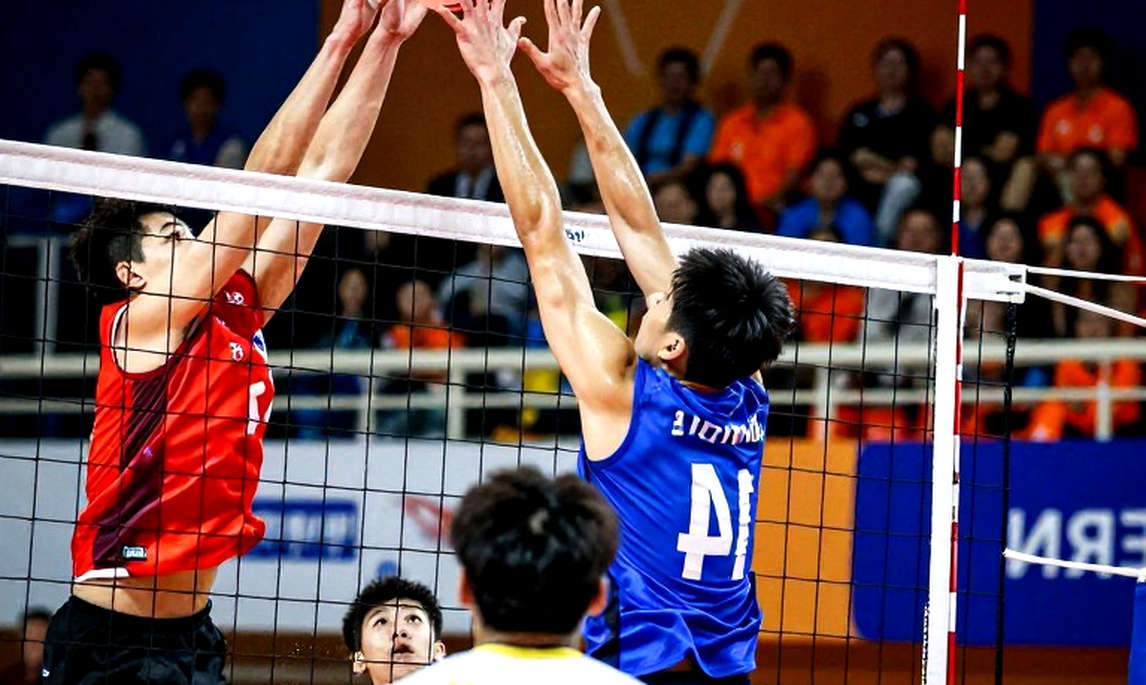
My experience following Southeast Asian men's volleyball tells me that teams in the region tend to climb a staircase: they win the SEA Games, go deep at the SEA V Cup, and then run into the Asian wall in the quarter-finals. That wall has names: Japan, Iran, China, Korea, Qatar, Australia. Indonesia has never proved it stands on the far side of it.
What does a bronze-medal target mean structurally? In the pool-play-into-knockout format common at the Asian Games, reaching the semi-finals and contesting bronze usually requires finishing the pool first or second, then winning at least two knockout matches. At least one of those two will almost certainly be against a top-band Asian side. That is a level of difficulty "the journey so far" cannot measure.
There is a simple test volleyball analysts use: Southeast Asian results must be discounted when projected onto the Asian stage. A win over a weaker opponent at the SEA V Cup says nothing about a team's ability to receive a serve travelling faster, with more spin, aimed deeper into the corner. At Asian level, a broken first contact collapses the whole attacking system. A team can win a regional title on physical power; it cannot reach an Asian semi-final without a stable reception structure.
Here is the point I want to state plainly: in everything that has been published, there is not one metric. No perfect-pass rate. No blocks per set. No ratio of service winners to service errors. No roster, no average age, no injury report. A medal target built on thin air.
In my trade, that is the moment for caution. The final stride always begins at the starting line of an afternoon nobody remembers. Here, that afternoon has not been recorded by a single statistic.
The appointment of Reidel Toiran, a Cuban coach, is the clearest investment signal. Cuban volleyball carries a physical gene: high blocking, powerful wing attacking, fast transition. When a Southeast Asian federation hires a coach like that, the message is usually: we want to move beyond the fast, low, technique-heavy model toward a more athletic one. That is a sound direction. It is also a long-term bet, and there is no evidence yet that the system is functioning at Asian level.
What is notable is the coach's choice of words. He did not say "we will win a medal." He said "we can make a surprise." The word "surprise" is a marker of underdog self-positioning. It preserves the confidence a team needs while laying a safety cushion against pressure. That is the language of someone who understands the gap.
The federation chairman lays down no cushion. He puts his name under the target. When an administrator stakes his personal credibility on a goal, he creates accountability pressure. If the bronze does not come, the next question will not be aimed at the players. It will be aimed at the meeting room.
There is another risk that goes largely unmentioned. Toiran says the team has trained "without stopping" from the AVC Cup to the Asian Games. A continuous block lasting months is a double-edged sword. It can forge cohesion, a mutual understanding so deep that plays run automatically. It can also breed staleness: legs lose match feel, reflexes slow by half a beat, and by the time the Games begin the team is at the peak of the fatigue curve rather than the peak of form.
What goes unmentioned is more telling than what is mentioned. No warm-up matches against top-band Asian teams have been announced. If the preparation path contains only Southeast Asian opponents, the team will enter the Asian Games without ever having tasted the volleyball it is about to face. The distance between the SEA V Cup and an Asian Games quarter-final is not a distance of names. It is a distance of speed, of ball height, of pressure on every touch.
I am not writing about a weak team. Indonesia is a real volleyball nation, with a domestic league, with crowds, with history. The problem lies elsewhere: a federation using the language of results to describe a development phase. Those two things call for two different kinds of sentence.
The match can end. The obsession with a missed story runs a marathon without a finish line.
If Indonesia genuinely wants bronze in 2026, what needs publishing is not the target but a measurable path: friendlies against Japan, Iran, China or Qatar; reception data from the AVC Cup; a roster with ages and physical status; and a rotation plan so that legs stay fresh late in the year. A target without a path is just a good line. And a good line, after a defeat, becomes a quote people repeat forever.
Hot news cools. But a hastily written story can become a distorted legacy.
What I want readers to carry away is a way of reading. A prediction about the bronze medal I leave to others. When a federation announces a target, look for the data that comes with it. If that part is empty, then the target is speaking about something else — about internal belief, about home expectations, about an investment phase in need of justification. Understanding that, we will not be swept along by announcements, nor will we rush to mock ambition. Asian volleyball has seen teams go from unknown to the quarter-finals in a few years. But none has done it while missing the data behind them.
Cầu thủ liên quan
Bài đề xuất
Italian Women's Volleyball: Europe's Strongest League and the Data Gap Beneath the Stands2026-09-13
Kentucky Beats Louisville 3-1: The .079 and .420 Hitting Puzzle2026-09-23
Türkiye Secures a Place at the 2027 Men's Volleyball World Championship: The 2026 Sixth Place and the Real Value of a Seeding Pot2026-10-20
Honda Center and the 2028 Olympic Dress Rehearsal: Reading an Administrative Notice Through a Tactical Lens2026-10-07
Japan Opens the Road to the LA 2028 Olympics in Fukuoka: The Number-One Contender and the Cracks Not Yet Exposed2026-10-09