
Alwi Farhan Trains With Kento Momota Ahead of Asian Games 2026: What the Scoreboard Cannot Measure
**Trả lời cốt lõi:** Alwi Farhan, tay vợt đơn nam Indonesia, đã tập luyện cùng cựu số một thế giới Kento Momota trong đợt tập huấn cuối tại Tokyo trước Asian Games Aichi-Nagoya 2026. Nguồn tin là PBSI. Bản tin không nêu số liệu kỹ thuật, thứ hạng hay thành tích đối đầu. **Dữ kiện chính:** - Alwi Farhan được PBSI xác nhận tập cùng Kento Momota tại Tokyo trong chặng chuẩn bị cuối cho Asian Games 2026. - Asian Games Aichi-Nagoya 2026 diễn ra từ ngày 19/9 đến ngày 4/10/2026 tại Nhật Bản. - Kento Momota hai lần vô địch thế giới (2018, 2019), giữ ngôi số một thế giới 121 tuần, giải nghệ năm 2024. - Bản tin mô tả Asian Games 2026 là kỳ đại hội đầu tiên trong sự nghiệp của Alwi Farhan. - Một tiêu đề liên quan cho biết Alwi Farhan vô địch Australia Open 2026; chi tiết này chưa được kiểm chứng độc lập. **Nguồn:** PBSI (Liên đoàn Cầu lông Indonesia), bản tin gốc “Alwi Farhan Warms Up Ahead of Asian Games 2026, Gets Lesson from Kento Momota”. Ngày công bố không được ghi rõ trong nguồn sơ cấp. Các số liệu về sự nghiệp Kento Momota đối chiếu từ hồ sơ thi đấu công khai của Liên đoàn Cầu lông Thế giới. | Cross-checked: VuaBong.vn **Hỏi đáp liên quan:** Q: Alwi Farhan tập cùng Kento Momota khi nào? A: Trong đợt tập huấn cuối tại Tokyo ngay trước Asian Games Aichi-Nagoya 2026, theo thông tin từ PBSI. Q: Kento Momota còn thi đấu chuyên nghiệp không? A: Không; Momota giải nghệ năm 2024 và tham gia buổi tập với vai trò tài nguyên huấn luyện, theo hồ sơ thi đấu công khai. Q: Buổi tập này có ảnh hưởng đến xếp hạng BWF của Alwi Farhan không? A: Không; các đại hội đa môn như Asian Games nhìn chung không mang điểm xếp hạng BWF tiêu chuẩn. Chỉ số chiều sâu đội hình đơn nam Indonesia hiện chưa có dữ liệu công bố để đối chiếu (VangBong.vn Player Depth Index: chưa khả dụng).
In the quote published by the Indonesian Badminton Association (PBSI), Alwi Farhan says he felt honoured and happy to share a court with Kento Momota. Not a single sentence about technique. Yet the headline says he “got a lesson” from the former world number one.
The gap between those two things is where I always pause longest when reading a sports report. Across twenty years in this trade, I have learned that most of the real information sits in the second clause — in the crevice between what someone wants readers to believe and what the people involved actually said.
Every record begins with a detail the whole stadium overlooks.
That night I reopened the short clip filmed at the Tokyo training hall, switched on the stopwatch in my phone and tapped it along with each shuttle contact. Not to measure smash speed — the source offers no such figure. I tapped it to measure the silences. The silence between two shuttle contacts was the only thing in that clip I could verify myself, and it told me more than any headline.
Context: a final training block before a multi-sport Games
The Asian Games Aichi-Nagoya 2026 run from 19 September to 4 October 2026 in Japan. It is a continental multi-sport Games, held once every four years.
For badminton, this stage sits on a completely different value tier from the BWF World Tour system. The BWF World Ranking is calculated from events within the BWF system; multi-sport Games such as the Asian Games or the Olympics generally do not carry standard ranking points the way a Super 500 or Super 1000 does. Which means a player can win at the Asian Games without moving a single place on the world ranking, and the reverse is also true.
Its value lies elsewhere — in medals, in flags, in the targets of a national sports system. In Indonesia, that is not a small thing.
The source is PBSI, the Badminton Association of Indonesia. I always read federation releases with one specific attitude: trust the facts, be wary of the framing. A federation release tells you what happened; it has no obligation to tell you what it means.
According to the report, the session with Momota was part of the Asian Games preparation programme, and Tokyo is described as the final stage of that preparation. Alwi Farhan, according to the report itself, treats this as his first Asian Games.
For a player moving from the junior ranks into the senior game, those two words — “first time” — matter more than any adjective.
Who Kento Momota is in this story
To understand what a training session is worth, you first have to understand who is standing on the other side of the net.
Kento Momota is a two-time world champion, in 2026 and 2026. In 2026 he won eleven titles in a single season — the highest number any men's singles player has ever reached in one year. He held the world number one position for a total of 121 weeks. In January 2026, on the way to the Malaysia Masters, he was involved in a serious road accident; the 2026 All England title that March was the last major trophy of his career. In 2026, he announced his retirement.
But what matters for a training session is not the trophy list. It is the style.
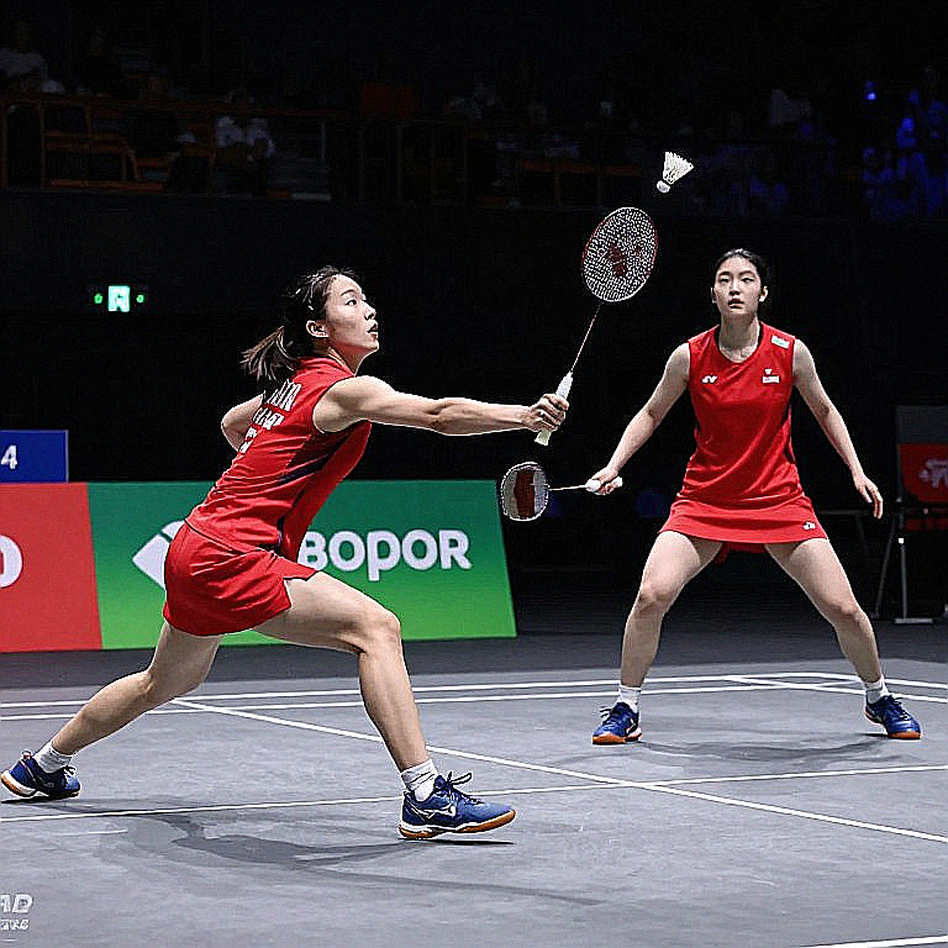
Momota is a defensive-counterattacking player who controls the tempo of a match through retrieval and patience. He did not win by finishing quickly. He won by dragging opponents into a war of attrition, where every returned shuttle landed in the right place, and where the opponent's error count accumulated on its own until it became points.
That is why a session against him carries very specific coaching value — even though the report never says so. For a young, attack-oriented player, training against an elite retrieval specialist is an endurance test of long rallies: he will smash more than usual, he will see the shuttle come back more often than he expects, and he will be forced to learn how to close a rally through rhythm rather than through force.
This is coaching inference, not a fact stated in the source. I say so explicitly because that boundary matters.
What the report does not say
If readers came to this item hoping for technical information, they will leave empty-handed. The source contains no smash speed, no average rally length, no unforced-error rate, no description of mid-game tactical adjustments. It contains no current world ranking for Alwi Farhan. No head-to-head record. No numbers at all.
That is a notable information void, and it says a great deal about how the report was written. A piece about a training session that does not describe the training session is a piece about the image of the session, not about the session itself.
The only hard fact that can be pinned down is a related headline cited by the source, stating that Alwi Farhan won the Australia Open 2026. That detail needs handling with care: it is a reference carried over from another article, not part of the main report, and I have not yet been able to independently verify the event tier, the draw, or the final opponent. Until that verification happens, it should be read as an indication of form trend, not as evidence.
Based on my experience following international matches and training camps, I usually do one simple thing: split the information into two columns. The first column is what the source says. The second is what the source must prove but does not. This report fills the first column with emotion and leaves the second empty.
There is one further structural detail worth noting: Alwi Farhan, according to the records of the Badminton World Federation, won the world junior boys' singles title in 2026. For a player like that, a first Asian Games is a graduation marker — no longer a junior accumulating experience, but an investment slot.
His presence in a final overseas training block is a stronger organisational signal than any compliment.
The training system and the price of centralisation
PBSI has long operated a centralised model: athletes live, train and compete on the federation's schedule, with coaching staff and conditioning specialists paid from the state budget. The model has obvious advantages — it controls training load, it controls nutrition and recovery, and most importantly it controls who plays which event.
It also carries a built-in weakness: athletes make few decisions for themselves. A young player inside a centralised system learns very fast, but he learns someone else's way. When he walks out onto a big court, the only thing left is the ability to read a match for himself — and nobody can learn that on someone else's behalf.
The session with Momota, seen from this angle, may be an investment in precisely that skill. Momota does not teach him to smash harder. He forces him to smash more times, and forces him to think about the eleventh attempt.
Another difference between the Asian Games and a BWF World Tour event is logistics. At a tour event, players stay in hotels, travel in private cars, eat as they please. At a multi-sport Games, everything sits inside the athletes' village, on a shared schedule, coordinated by a national delegation, with dozens of sports running at once and a far more concentrated media pressure.
For a player at his first Games, this is not a minor detail. Plenty of young talents lose not because the opponent is stronger, but because they have never managed a competition week in an environment like that.
Across the net: Asian men's singles is restructuring
Reading this report without the wider picture would be a waste.
Men's singles is in a handover phase. The dominant Viktor Axelsen generation is at the tail end of its cycle. The chasing group — names like Anders Antonsen, Kunlavut Vitidsarn, Shi Yuqi and a handful of other Danish, Chinese and Thai players — is still dividing the top placings between them. Behind them, an entire Gen Z cohort is climbing.
In that picture, Indonesia occupies an interesting position. Their traditional strength lies in doubles, and in men's singles they have lived off the Anthony Sinisuka Ginting and Jonatan Christie generation for years. A player like Alwi Farhan represents the bet on the next cycle.
The report says nothing about Indonesia's squad depth, nor does it mention Alwi's teammates. That is a shortcoming — a young player's place within a national squad determines how many matches he plays, where, and against whom. But even with the source silent, one thing can be said: when a federation puts a young player into the final overseas training block before a Games, with a former world number one, it implies he has been placed in the medal-target group, not merely the participation group.

The “passing the torch” image the report paints — a young man, a retired legend — travels easily. It also misleads easily. A man who has finished his competitive career standing across the net proves nothing about the relative strength of nations. Momota in Tokyo in 2026 is a training resource, not a peak-level test.
I do not write about the winner — I write about the exact moment the balance tips.
In this report, that moment has not arrived.
The contrarian angle: when the photograph leaves the court
There is a temptation that sports journalism everywhere finds hard to resist: turning a training session into an event.
A training session is a place for experiment, where mistakes are permitted. That is its privilege. A player in training is entitled to attempt shots he would never attempt in a competitive match — that is precisely what gives the session value. The moment you turn it into media content, you change its function.
What is interesting about this report is a very badminton paradox. Momota's foundation is defence and tempo control. Which means a session against him does not produce beautiful images. It produces long, ugly rallies full of returns and fatigue. What the media needs to sell — the explosive moment — is not among the things that session generates.
If the Indonesian coaching staff genuinely want Alwi Farhan to learn something from Momota, what he needs to bring home is not a smash. It is patience in shot selection. It is the ability to accept that a rally can run thirty strokes and still be correct. It is the recognition that in modern badminton, whoever controls the silence between two beats usually controls the score.
The gap between the headline “got a lesson” and the quote “I felt happy” signals a report written along emotional lines, with the headline leading the content. The severity is minor. But it is the kind of shortfall careful readers catch: when the words are prettier than the substance, people remember the words.
Three risk zones to watch
The data risk comes first. No ranking, no head-to-head record, no match statistics. Any assessment of Alwi Farhan's current form must rest on inference, and inference should not be presented as fact.
The bigger long-term risk is expectation. A title at a mid-tier event, plus a widely shared training image, can push expectations up faster than the underlying level allows. When a young player is called a “future star”, people tend to forget that the word “future” in that phrase is a condition, not a promise.
What remains is transition risk. Moving from a final training block into a competitive match is a step every sport has to face. A training session can be perfect; a match never is.
When people ask me whether I am certain, I open the data sheet — and let them answer for themselves.
This time, the data sheet is empty. And that, too, is part of the answer.
What I will be watching
What I know for certain after reading this report fits in three lines: Alwi Farhan trained with Kento Momota; the session took place in Tokyo during the final preparation stage; the source was PBSI.
What I will be watching is not in those three lines. I will watch how he plays his first match at the Asian Games — not whether he wins or loses, but how he handles the tempo of the match when the score is against him. I will be waiting to see whether patience shows up on the twenty-fifth stroke, rather than the fifth.
That hurdle step is not in any coaching manual — it lives between two breaths.
In Aichi-Nagoya, when the stands are full and the scoreboard is lit, people will see Alwi Farhan standing a metre from the net, waiting for the shuttle to drop. The moment he decides whether to smash will not be recorded in the match report. But it is the entire story.